Is The E Silent In Seine?
The short answer to how Seine is pronounced in French, plus how the name shows up on Paris docks, boats and dinner cruise bookings.
Is The E Silent In Seine?
Yes, the final e is silent. In French, Seine is pronounced /sɛn/, a single syllable that rhymes roughly with the English word "sen," with a short e as in "bed" and no spoken ending. The common English rendering "sane" adds a vowel sound French speakers never use, so one syllable, silent e, is the whole rule.
That is the entire linguistic answer, and it is worth getting right, because the word is printed on tickets, dock signs, boarding passes and boat hulls all over Paris. French phonetics spells it out plainly: the letters "ei" make the short e vowel, the "n" closes the syllable, and the trailing "e" does nothing at all to the sound. It is the same silent final e you hear (or rather do not hear) at the end of countless French words, from "table" to "Parisienne." If you can say "men" you can say "Seine."
The mispronunciation is understandable. English speakers see "Seine," pattern-match it to words like "seine" the fishing net or the English long-a sound in "sane," and use an English long-a vowel rather than the French vowel. French reference sources, including the French Wiktionary entry for Seine, give the single-syllable /sɛn/ transcription, and native audio recordings on pronunciation sites agree. In standard French pronunciation, the final e is silent.
Why does this matter for a cruise site? Because the word is the product. Every operator in Paris, from the oldest sightseeing companies to the smallest dinner boats, trades on the name, and the name is everywhere once you start booking: "croisière sur la Seine" on the signage, "Seine River cruise" on the English listings, "Bateaux sur Seine" painted on hulls. Saying it correctly is a small thing. Recognizing it correctly on a dock announcement, when a crew member calls the boarding point over a loudspeaker in fast French, is genuinely practical, and that is where this page goes next.
How Does The Pronunciation Show Up At The Docks And On The Boats?
You will hear "Seine" spoken constantly at Paris embarkation points, always as one syllable, and the name appears in the French names of operators, docks and announcements. Dock announcements, ticket checks and crew directions use the French pronunciation, so matching it helps you find the right pontoon, especially at busy Eiffel Tower quays.
The practical surface of the word is bigger than most visitors expect. The main sightseeing companies embed "Seine" or a boat-on-the-Seine identity directly in their branding, and their staff announce departures in French first. At Port de la Bourdonnais at the foot of the Eiffel Tower, at Port de la Conférence near Pont de l'Alma, at Pont Neuf and at the quays near Notre-Dame, the pattern is the same: a crew member or recording says the French name, then switches to English. If you are listening for "sane" you will simply miss the call.
There is a useful detail here that a first page of search results will not tell you. The oldest brand on the river, Compagnie des Bateaux Mouches, has been operating since 1949, and its name deliberately does not contain the word Seine at all: "bateaux mouches" literally means "fly boats," a nickname the fleet earned decades ago. So on the water you will hear the river's name from announcements and commentary, but the biggest company on it is named after an insect. Meanwhile the operator names that do contain the river's name, and there are several, all pronounce it the same single-syllable way.
A quick orientation table helps, because the names blur together fast when you are standing on a quay:
| Where you'll hear it | What it sounds like | What it refers to |
|---|---|---|
| "Seine" in any announcement | one syllable, "sen" | the river itself |
| "Bateaux Mouches" | ba-TOE MOOSH | the 1949-founded sightseeing and dinner operator |
| "Croisière sur la Seine" | krwah-ZYAIR sur lah SEN | any cruise on the river, the phrase on most signage |
| "Bateau à passagers" | ba-TO a pa-sa-ZHAY | passenger boat, the regulatory term crews use |
The pronunciation also matters when you are reading rather than listening. French signage at the docks gives quay names and port names that pair with the river, and boarding instructions on tickets often mix French and English: "Port de la Bourdonnais," "embarquement," "croisière d'une heure." Knowing that "Seine" is one syllable trains your ear for the rest, because French signage and announcements move quickly and do not slow down for the river's name.
Which Seine Cruise Matches The Word On The Hull?
Once you can say the name, the choice becomes practical: a narrated one-hour sightseeing loop from the Eiffel Tower, a long Italian dinner cruise, or a nightlife-oriented gourmet sailing with live music. The three formats differ more in duration and food than in route, since almost every boat passes the same monuments.
That last point deserves emphasis, because it is the single most useful fact for choosing. The standard sightseeing route past the Eiffel Tower, Notre-Dame, the Louvre and Musée d'Orsay is shared by nearly every operator, so the word "Seine" on a listing tells you almost nothing about what you will actually see. What differentiates products is duration, food, departure point and atmosphere. A one-hour loop and a multi-course dinner sailing cover overlapping water.
The Italian option is the unusual one. The Trattoria on Seine dinner cruise, run by Le Diamant Bleu on the Théo boat, boards at 2 Rue du Ranelagh near the Eiffel Tower and runs about 2.5 hours. It is the only Italian-cuisine dinner cruise found on the river: antipasti to start, fresh pasta mains such as lasagne or cacio e pepe, tiramisu to finish, with bar drinks sold separately. The boat is intimate, with a panoramic terrace, family-friendly seating and no live entertainment, which makes it a quieter contrast to the music boats. The rating sits roughly in the 4.0 to 4.2 range across sources that disagreed, with 1,359 reviews, so the live listing has the current figure.
For context, the same operator runs a very different evening. The Paris Gourmet Dinner Seine River Cruise with Singer and DJ Set offers service-dependent sailing times from the same boarding point: a three-course gourmet menu, a live singer plus DJ set with dancing, silver service and optional Champagne. It rates 4.4-4.5/5 with 1,839 reviews, and the live listing has the current price. If your evening plan is dinner plus a party, that is the format; if your plan is pasta and conversation, the trattoria is the better fit.
At the other end of the scale sits the default sightseeing product. Bateaux Parisiens runs the Paris 1-Hour Seine Cruise departing from the Eiffel Tower, a round trip from Port de la Bourdonnais on a modern boat with a top deck plus indoor seating, rated 4.4/5 with close to 90,000 reviews and a price from $21 per person. Audio commentary comes through an app in up to 14 languages, and the loop passes Notre-Dame, the Louvre and Musée d'Orsay. It is the most-booked sightseeing product in its set, and for a first visit it is the cheapest full introduction to the river the name refers to.
What Does A Seine Cruise Cost Once You Have Picked A Format?
Sightseeing cruises in 2026 run about EUR 15-21 per person online across operators, with Batobus's hop-on-hop-off day pass at the top of that range at EUR 23, while dinner cruises start from $76 per person for a full three-course meal and climb steeply from there.
The pricing spread is wide because the products are genuinely different things: a transportation-and-commentary loop, a meal on the water, and a party. The budget anchor in the dinner category is the Paris en Scène bistro-style three-course cruise, from $76 per person, departing Port de Javel Haut in the 15th arrondissement for a 1h45m sailing. Above that, Bateaux Parisiens' 3-course gourmet dinner cruise runs from $101 per person, and the flagship Bateaux Mouches dinner cruise with live piano and violin starts from $133 per person.
For planning, compare the actual cruise departure, boarding instructions and ticket terms. A timed dinner service and a sightseeing ticket can have different check-in rules, so use the selected listing rather than a general lead-time estimate.
| Product type | Typical 2026 price | What it includes |
|---|---|---|
| 1-hour sightseeing cruise | about EUR 15-21 per person | narrated or audio-commentary loop past the main monuments |
| Hop-on hop-off day pass | EUR 23 adult, EUR 13 child for 24 hours | transport between 9 stops, no narration |
| Bistro dinner cruise | from $76 per person | 3-course French meal, about 1h45m |
| Flagship dinner cruise | from $133 per person | 3- or 4-course menu, live music, about 2h15m |
One more honest note from recent traveler reports: queue waits of 15-60 minutes have been documented even with pre-purchased tickets in peak periods, and one October 2025 review flagged a premium seat upgrade that did not deliver the promised view because of an obstructed window. Booking ahead does not always mean skipping every line, so build in buffer time, especially for evening sailings.
When Should You Say It: Day Cruise Or Night Cruise On The Seine?
Morning sailings bring lighter crowds, calmer decks and better natural light for photography, while evening and dinner departures trade that for illuminated monuments and the Eiffel Tower's hourly sparkle, which runs five minutes at the start of every full hour after dusk until midnight, or 1am in summer.
The sparkle schedule is the single most common reason people book an evening slot, and it is worth understanding precisely. The tower sparkles for exactly five minutes at the top of each hour after sunset, with the first show falling on the first full hour after dusk: roughly 6pm in deep winter, 7-9pm in spring and autumn, and around 10pm in midsummer. Dinner cruise departures, which typically cluster around 6:15pm, 8:15-8:30pm and 9:15pm slots, are timed so that later sailings usually catch the show.
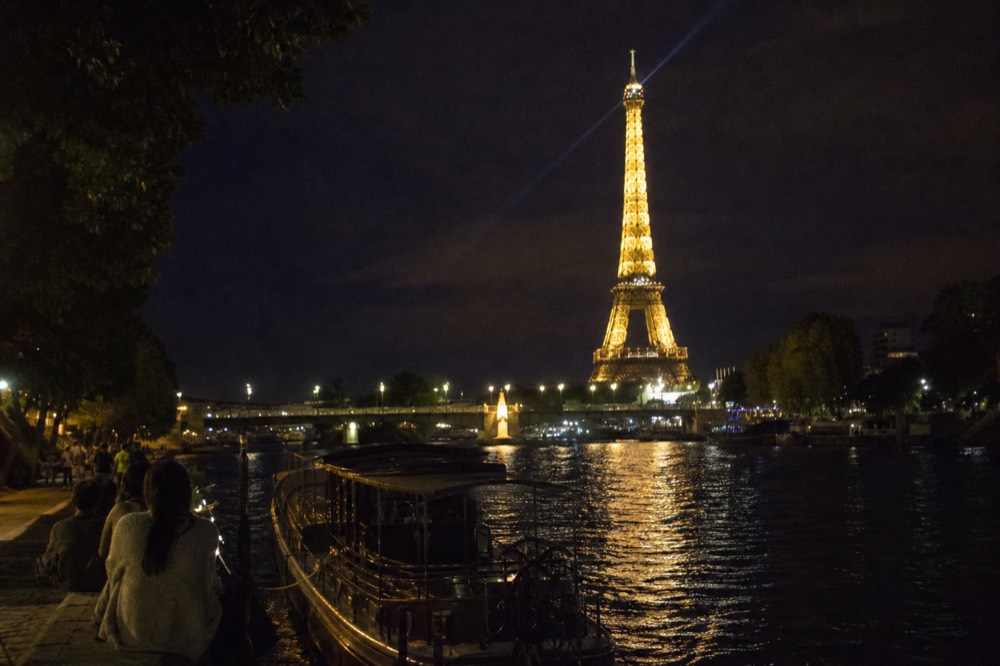
Daytime has its own case. Traveler reports from 2025-2026 consistently favor morning departures for fewer passengers and calmer light, and recommend arriving 30-45 minutes early if you want an upper-deck railing seat, especially in the evening when top spots are claimed fast. The trade is simple: daylight gives clearer views of the architecture, night gives the illuminated bridges and the sparkle. If you want the narrated, relaxed loop, see our longer treatment in the best time for a Seine river cruise.
For choosing between operators rather than times, the comparison is mostly about departure point, boat size and commentary style, and 2025-2026 forum sentiment draws those lines clearly. Reddit threads in r/ParisTravelGuide consistently describe Bateaux Parisiens as the most convenient Eiffel Tower departure, Bateaux Mouches as the largest and most classic-feeling boats with the most crowding, and Vedettes de Paris as the quietest ride thanks to electric propulsion. Our full operator comparison guide breaks down the differences in detail, and if dinner is the goal, the Seine river dinner cruise guide covers dress codes and menus.
Whichever format and hour you land on, the booking mechanics stay consistent across the river. Sightseeing tickets are flexible enough to buy days or hours ahead, dinner cruises reward booking well in advance, and every operator's live listing carries the current price, schedule and cancellation terms. The trio below spans the full spread of what the name on the hull can mean in practice, from a one-hour loop to a long Italian dinner to a night of live music and dancing.
The short answer is that the final e is silent and the name is one syllable, but the questions below cover the follow-ups travelers actually ask: how to say it, whether Parisians notice, whether the rule extends to other French words, and whether pronunciation matters at all when booking a ticket on the river.
Common Questions About Pronouncing Seine
Is the E silent in Seine?
Yes. The final e is completely silent. Seine is one syllable in French, pronounced /sɛn/, rhyming roughly with "sen" as heard in the English word "men." The English-style pronunciation "sane" changes the vowel; it is also one syllable.
How do you pronounce Seine in French?
Say it as a single syllable: "sen," with a short e as in "bed." The letters "ei" produce the vowel, the "n" closes the syllable, and the final "e" is not pronounced at all.
Do Parisians care if you mispronounce Seine?
Not much. Parisians hear the anglicized version constantly from visitors, and crew members at every embarkation point are used to it. Matching the one-syllable French pronunciation simply makes dock announcements and directions easier to follow.
Does the silent e rule apply to other French river names?
The silent final e is standard French spelling, not a rule specific to this river. It behaves the same way in thousands of French words, which is why the trailing e in Seine, like the trailing e in most French nouns, has no sound.
Will knowing the pronunciation help when booking a cruise?
Only indirectly. Listings, tickets and dock signage in English spell the name out, so booking is straightforward either way. Where the one-syllable pronunciation genuinely helps is on the ground, when French announcements call boarding points and departures at busy quays.
The word on the hull is the easiest part of the trip to master, and it takes about three seconds. The harder choices, which boat, which meal, which hour of the evening, are what Cruise in Seine River exists to untangle, and every guide on the site starts from the same honest baseline: one river, one syllable, and a dozen genuinely different ways to see it.
Your Next Step On The Seine
Paris Conversational French Language Class at Famed Café de Flore
Ready to practise French beyond this one word? Check your date for the 90-minute conversation lesson and neighborhood walk.
90-minute French conversation lesson and neighborhood walk, with an English-speaking teacher, up to five participants and a coffee or soft drink. Meet outside Saint-Germain-des-Prés church. Café may change if crowded. No hotel pickup.
Adjust Your Choice And Compare Costs
Start with this general recommendation, or choose what matters to you. Durations are listed with each option. Allow additional time to reach the meeting point and check in.
- Paris Conversational French Language Class at Famed Café de Flore
- 90-minute French conversation lesson and neighborhood walk, with an English-speaking teacher, up to five participants and a coffee or soft drink. Meet outside Saint-Germain-des-Prés church. Café may change if crowded. No hotel pickup.
- Seine River Guided Cruise by Vedettes de Paris
- one-hour electric sightseeing cruise with live English/French guide from Eiffel Tower. Champagne/snack upgrades optional. 60 minutes cruising; arrive 20 minutes early.
- Paris Theo Boat Seine River Italian Trattoria Style Dinner Cruise
- Italian three-course dinner on Theo boat; pasta and tiramisu, optional VIP window seating. 150 minutes total including boarding; product explicitly states 120 minutes cruising. Special options vary.
Choose a date to see published departures. Seats and final prices are confirmed on Viator.
No listed experience fits those choices. Adjust the experience or time, or reset to the general recommendation.